Hester Prynne
Hester Prynne stands at the center of Nathaniel Hawthorne's The Scarlet Letter as a figure of immense complexity—a woman publicly shamed for adultery who, over seven years, transforms the emblem of her disgrace into a badge of resilience, charity, and quiet rebellion. Her journey from the scaffold to a life of penitent service, and finally to a role as a proto-feminist counselor, traces the novel's deepest concerns with sin, identity, and the possibility of redemption within a rigid Puritan society.
Identity and Introduction
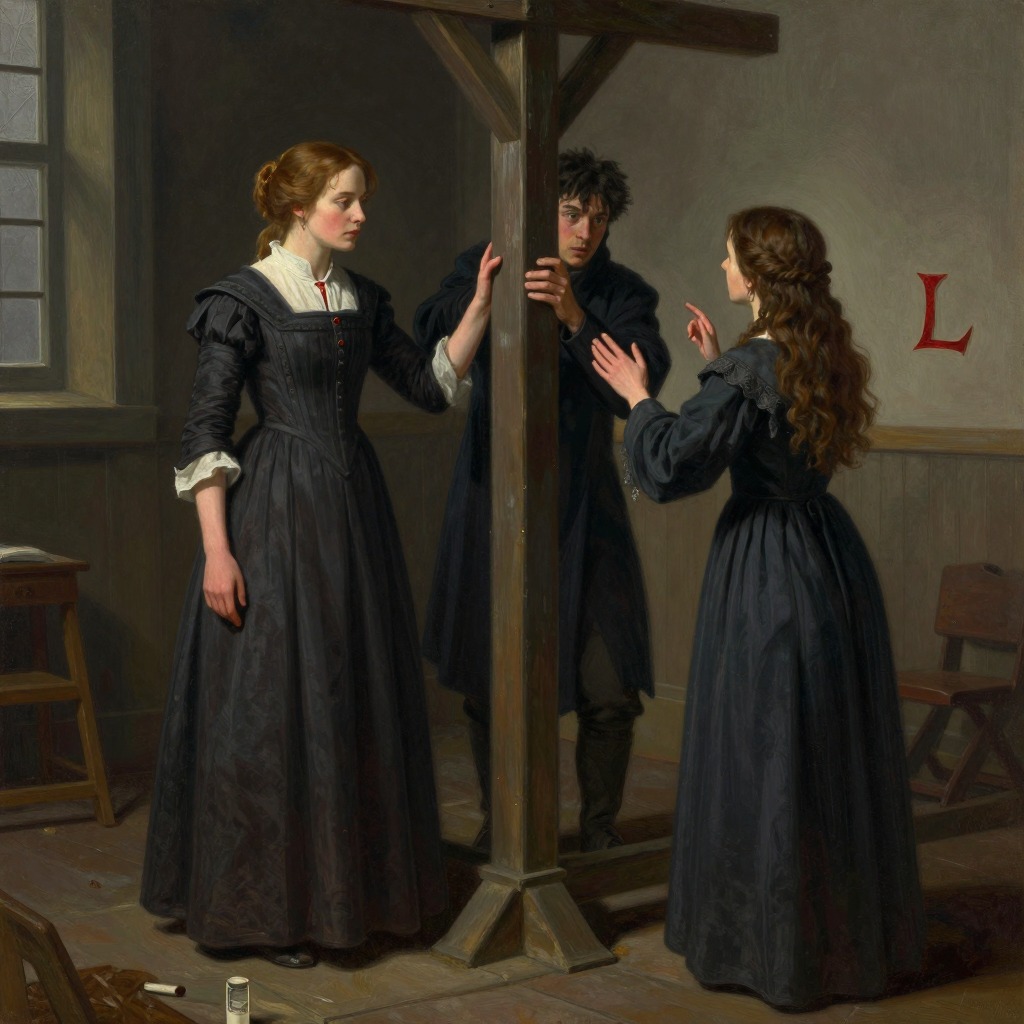
Hester Prynne is introduced as a tall young woman with a figure of perfect elegance on a large scale, dark and abundant hair so glossy that it threw off the sunshine with a gleam, and a face beautiful from regularity of feature and richness of complexion, with a marked brow and deep black eyes. She is ladylike in the antique interpretation of the term, characterized by a certain state and dignity. When she emerges from the prison door, she appears not dimmed by her disgrace but with her beauty shining out, making a halo of the misfortune and ignominy that envelops her. On the breast of her gown, in fine red cloth surrounded by elaborate embroidery and fantastic flourishes of gold thread, appears the letter A, so artistically done that it has all the effect of a last and fitting decoration to her apparel. This scarlet letter, fantastically embroidered and illuminated upon her bosom, has the effect of a spell, taking her out of the ordinary relations with humanity and enclosing her in a sphere by herself. The women of the crowd, particularly a hard-featured dame of fifty, express outrage that she should make a pride out of what the magistrates meant for a punishment, while a younger wife notes that the pang of the mark will always be in her heart. Hester's own demeanor is marked by a burning blush, yet a haughty smile, and a glance that will not be abashed as she looks around at her townspeople and neighbors.
Life and Plot Trajectory
After her release from prison, Hester does not flee Boston, though she is free to return to her birthplace or any other European land. Instead, she establishes herself with her infant child, Pearl, in a small thatched cottage on the outskirts of town, on the shore looking across a basin of the sea at the forest-covered hills. The chain that binds her there is of iron links, galling to her inmost soul, but never to be broken. She supports herself and Pearl through her extraordinary skill at needlework, an art that becomes the fashion in the colony. Her handiwork is seen on the ruff of the Governor, on military men's scarfs, on the minister's band, and on babies' caps, though it is never called upon to embroider a bride's white veil. Hester herself wears only the coarsest materials and most sombre hue, with only the scarlet letter as ornament, while she dresses Pearl in fanciful, fantastic ingenuity. She bestows all her superfluous means in charity on wretches less miserable than herself, who often insult the hand that feeds them, and she employs much of her time making coarse garments for the poor, offering up a real sacrifice of enjoyment. Over the years, her blameless purity of life and her self-devotion during times of pestilence and calamity cause a species of general regard to grow up in reference to her. Many people refuse to interpret the scarlet A by its original signification, saying that it means Abel, so strong is Hester Prynne with a woman's strength. The rulers and wise men are longer in acknowledging her good qualities, but individuals in private life have quite forgiven her, looking upon the scarlet letter as the token not of her sin but of her many good deeds since.
Key Actions and Objectives
Hester's central objective is to protect and raise her daughter Pearl, whom she calls "of great price—purchased with all she had—her mother's only treasure." When she learns that Governor Bellingham and other leading inhabitants plan to deprive her of her child on the supposition that Pearl is of demon origin, Hester goes to the Governor's mansion to plead her case. There, she confronts the magistrate with a fierce expression, crying, "God gave me the child! He gave her in requital of all things else which ye had taken from me. She is my happiness—she is my torture, none the less! Pearl keeps me here in life! Pearl punishes me, too! See ye not, she is the scarlet letter, only capable of being loved, and so endowed with a millionfold the power of retribution for my sin? Ye shall not take her! I will die first!" She turns to the young clergyman Arthur Dimmesdale, her pastor, and appeals to him to speak for her, which he does, successfully arguing that the child was meant to keep the mother's soul alive and to preserve her from blacker depths of sin. Later, after witnessing the minister's intense misery and recognizing that Roger Chillingworth, her former husband, is tormenting him under the guise of a friend and physician, Hester resolves to reveal Chillingworth's true identity to Dimmesdale. She meets the minister in the forest and confesses, "That old man!—the physician!—he whom they call Roger Chillingworth!—he was my husband!" She then urges Dimmesdale to flee with her and Pearl, proposing they take a ship to Europe, and she secures passage for them. When she learns that Chillingworth has also booked passage on the same ship, she faces the prospect of her plan being thwarted.
Relationships and Conflict
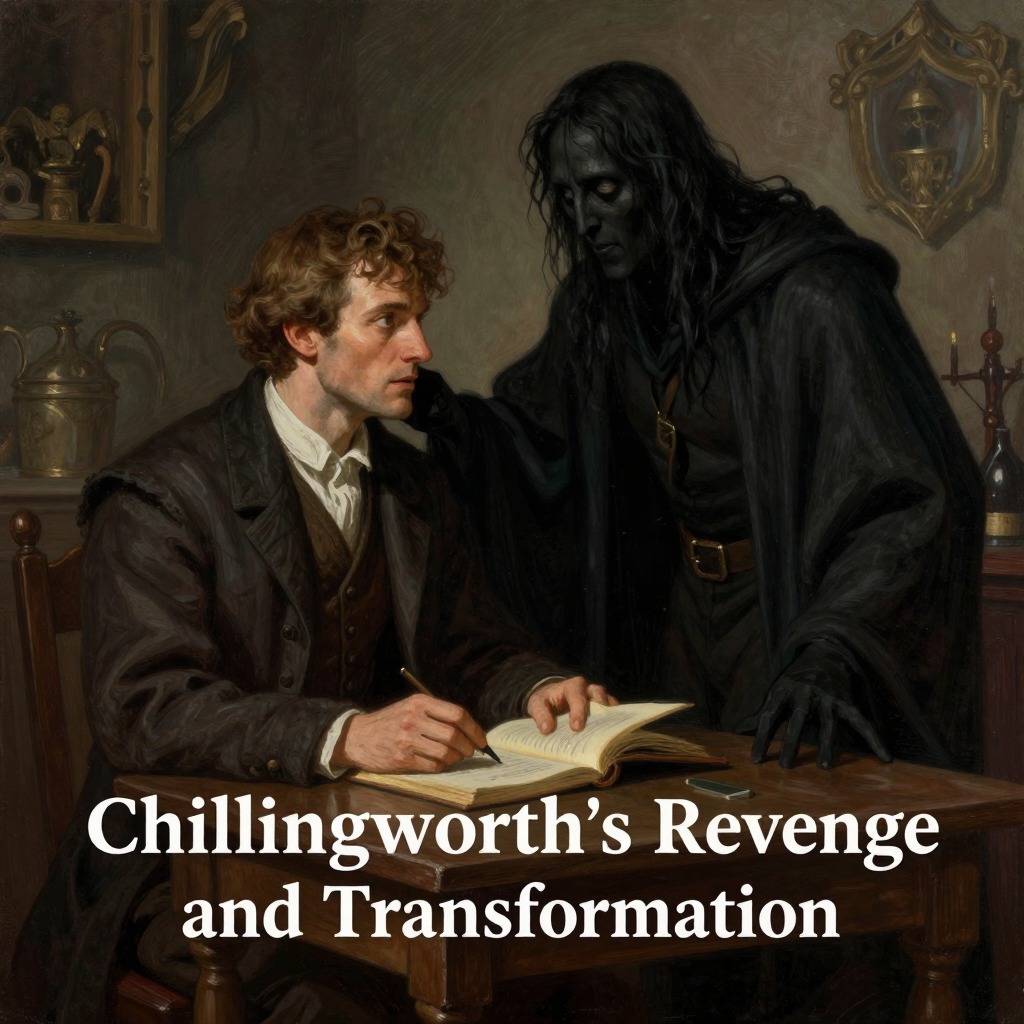
Hester's relationship with Pearl is the most intense and complex of her life. Pearl is a strange, elfish child who seems to be the living embodiment of the scarlet letter, and Hester both loves her and is tortured by her. Pearl's first conscious object is the scarlet letter on her mother's bosom, and she grasps at it, smiling, causing Hester infinite torture. The child's perverse merriment and her refusal to cross the brook to join Hester and Dimmesdale until Hester resumes the scarlet letter demonstrate the deep, almost mystical connection between mother and daughter. With Arthur Dimmesdale, Hester shares a bond of mutual crime and love. She keeps his secret for seven years, but when she finally reveals Chillingworth's identity, Dimmesdale initially cannot forgive her, crying, "Woman, woman, thou art accountable for this!—I cannot forgive thee!" Yet he eventually does forgive her, and they plan to escape together. With Roger Chillingworth, Hester's relationship is one of profound wrong and bitter hatred. She had married him without love, and he acknowledges his own folly in betraying her budding youth into a false and unnatural relation with his decay. After he discovers her sin, he forces her to swear an oath to keep his identity secret, and he devotes himself to tormenting Dimmesdale. Hester comes to hate Chillingworth, saying, "I hate the man!" and reflecting that he betrayed her and did her worse wrong than she did him. The conflict between Hester's desire for truth and her obligation to keep Chillingworth's secret, and between her love for Dimmesdale and her guilt over the harm she has caused him, drives much of the plot.
Change and Ending
Hester undergoes a profound transformation over the course of the novel. The scarlet letter, which initially marks her as an object of scorn, becomes a symbol of her charity and strength. Her rich and luxuriant hair is either cut off or hidden by a cap, and her face loses its former beauty, taking on a marble quietude. Much of the marble coldness of her impression is attributed to the fact that her life has turned from passion and feeling to thought. She assumes a freedom of speculation, thinking thoughts that dare to enter no other dwelling in New England. After Dimmesdale's death, Hester disappears with Pearl, and for many years no authentic tidings of them are received. But eventually, Hester returns alone to the cottage by the sea-shore and resumes the scarlet letter of her own free will, for not the sternest magistrate would have imposed it. Never afterwards does it quit her bosom. In the lapse of the toilsome, thoughtful, and self-devoted years that make up her life, the scarlet letter ceases to be a stigma and becomes a type of something to be sorrowed over, looked upon with awe and reverence. People bring all their sorrows and perplexities to her, and she comforts and counsels them, especially women suffering from wounded, wasted, or erring passion. She assures them of her firm belief that at some brighter period a new truth would be revealed to establish the whole relation between man and woman on a surer ground of mutual happiness. After many years, she is buried in a new grave near an old and sunken one, with a space between as if the dust of the two sleepers had no right to mingle, yet one tombstone serves for both, bearing the device: "ON A FIELD, SABLE, THE LETTER A, GULES."
Narrative Role and Evaluation
Hester Prynne functions as both the central character and the moral touchstone of the novel. Her public shaming on the scaffold establishes the initial conflict, and her subsequent life of quiet endurance and charity provides a counterpoint to the hypocrisy and hidden guilt of the Puritan community. Through her, Hawthorne explores the themes of sin, punishment, and redemption, as well as the oppressive nature of patriarchal society. Hester's transformation from a woman defined by her transgression to a figure of wisdom and compassion who counsels other women on their sorrows positions her as a proto-feminist figure, one who looks forward to a time when the relationship between men and women will be founded on mutual happiness. Her final return to the cottage and her voluntary resumption of the scarlet letter underscore the novel's insistence that true penitence is not an escape from the past but a lifelong engagement with it. The scarlet letter, which began as a mark of shame, becomes through Hester's agency a symbol of her unique strength and her enduring humanity.